The primary problems in Asia are 1) North Korea, 2) China-Taiwan, 3) China-Japan dispute over islands, 4) South China Sea ownership dispute, 5) Trans-Pacific Partnership, 6) Chinese human rights abuses, 7) Tibet, 8) China’s currency valuation, 8) Kashmir, 9) Myanmar.
North Korea—Ever since the 1930’s when our allies tried to appease Hitler and it came back to bite them in the ass, world leaders have done everything possible to avoid being labeled as an “appeaser”, and to a large degree I don’t blame them. Decisions made through strength always long outlast ones made through weakness.
Everyone agrees that the continued division of North & South Korea is an anachronistic relic of the Cold War and really a loose end of even World War II. The problem that has vexed everyone for decades is how to resolve it, because the first Korean War was horrific and bloody and no one wants that again, particularly considering how prosperous South Korea is now and that their capital of Seoul is within artillery range of literally thousands of North Korean guns. About half of South Korea’s population lives in the greater Seoul area (25 million out of 51 million).
It has taken us a long time due to the secretive nature of North Korea to really fully understand where they are coming from and what their objectives are, but it is clear now that the goal of the Kim family ‘dynasty’ is simply to stay in power for as long as they can, regardless of how much the people of the country suffer.
Even if they gave up their nuclear weapons, they still wouldn’t want to throw open the gates and let North & South mingle and for the North to become an open society and trade freely with the outside world….because then the Kim’s would lose power.
If they were any other two bit dictatorship in the world, the decision would be an easy one….assassination and/or invasion followed by occupation, liberation, and reunification with the South. Unfortunately, even if they didn’t have nuclear weapons, they’ve been indoctrinating and brainwashing their populace for decades that all of those steps would be a very long process.
When East Germany reunified with West Germany, there was an economic and social imbalance there as well and it was quite an adjustment for the East Germans for a while to “catch up” to the rest of the country. It will be the same for the North Koreans, only far more of a climb to reach parity, possibly taking several decades.
So what is the solution then? It sounds counter-intuitive, because it seems like we are rewarding their decades-long bad behavior and giving them a chance to claim victory, but we need to cut their strength from under the regime by completely opening up trade and social barriers.
Get all sorts of modern business and products into the country. Get social interactions with the rest of the world going. Make the North Koreans start to feel real prosperity for the first time. In short, give the average North Korean something to lose other than their ‘dear leader’.
Right now they are so tied to the Kim regime, but down the line after tasting “the good life”, they will be demanding reunification on their own and will forsake the Kim regime and nuclear weapons in favor of an extension of South Korea’s democracy on their own.
The only other option is war, but not coming from the South, but from China. North Korea only continues to survive because China allows it. China doesn’t want a unified Korea with a heavy American military presence on its border. North Korea has been directing the vast majority of its military forces towards the South for decades and has left its northern frontier far more lightly defended because it views China as an ally.
China would need to take the lead and invade from the north, drawing North Korean forces away from the DMZ with South Korea. The South and the US would have to stay out of the war and allow the Chinese to topple the North Korean regime and only then after it has been pacified and the nuclear weapons secured, at the invitation of the Chinese government could reunification talks begin, with the understanding that the US would eventually pull out of all its South Korean bases in exchange for China agreeing to also pull out of North Korea and neither country ever re-invading the peninsula unless unforeseen circumstances required a joint invasion.
The problem with even China invading is that there’s no guarantee Kim wouldn’t use his nuclear weapons and/or shell Seoul and South Korea to try and draw in the US and South Korea in a final inferno, kind of how Saddam Hussein tried to draw in Israel and the greater Muslim world by firing Scud Missiles at the outset of the first Gulf War.
The war option really should be the last resort, because it simply isn’t worth risking 51 million lives in South Korea to liberate another 25 million in the North, regardless of how tragic their living conditions.
The risk of the “appeasement” or “opening” option is that it could somehow embolden other rogue nations to take the same approach that North Korea did, but that risk is minimal.
No two situations in the international arena are ever identical, and how many nations would really be willing to subject their people to 7 decades of abject poverty and isolation while pursuing nuclear weapons just to then finally get equal treatment and economic prosperity?
If the opening option would be considered a North Korean victory, it would be the very definition of a “Pyrrhic victory”.
Any way you slice it, the Kim regime’s days are numbered. The only question is how many North Koreans have to die from malnutrition, disease, and ignorance before they are a free people.
China-Taiwan—Another tricky and complex loose end from World War II. If the Communist Chinese had the capability in 1949 to over-run the fleeing ROC (Republic of China) forces that sought refuge on Taiwan, then today this would be a moot point, and Taiwan would be just another Chinese province. But they weren’t able to, and it has been a stalemate for 7+ decades, during which time Taiwan has become a multi-party democracy, a critical economy to the rest of the world (as the COVID pandemic proved), and created its own identity for itself and in the eyes of the world.
The PRC (People’s Republic of China) has been consistent from day one in the 1940’s that they view Taiwan as a breakaway province that must be reunified under mainland control, and that if peaceful reunification cannot be achieved they will act militarily to reunify. In Taiwan, there has been a growing sentiment to just declare their independence already and move on with life. So what to do?
Relations between nations can sometimes mirror the relations between two individual people. Let’s say that two people fall in love and then they fall out of love and separate and are apart for many years, even though one of them during that whole time consistently wishes for reconciliation. Is it realistic to expect that one of them can force or coerce the other into loving them again and being a couple again? Or is it better to try and start over again, as friends, taking it slow and seeing where things lead over time through an increased bond of affection?
Because both the PRC and ROC are successful and prosperous places, a war to force reunification would not only be costly and a tragedy, but it would foster hard feelings for decades if not centuries. Look at the remaining animus still in the southern United States about our own civil war, over 150 years after the fact.
Taiwan has a millennium long history with mainland China, particularly within the last 5 centuries, and this issue must be resolved on a friendly basis.
In order to do so, it must happen gradually and of its own accord and cannot be rushed. The PRC must agree to never invade Taiwan, and Taiwan must agree to give up any claim or hope to re-take mainland China. Taiwan must also agree to not declare its independence for 100 years from the time relations are normalized between itself and mainland China. This will give the population of Taiwan just about as much time to re-acclimate to the mainland as it had been away from it since it was first occupied by the Japanese in the early 1900’s and then ruled by nationalists after the end of the Chinese Civil War.
During that 100 years, the PRC and ROC should be working together like long lost brothers….each having the final say in their own lands, but working jointly together on the international stage with the PRC having the final say in international matters. Neither should try and interfere in the internal politics of the other, and citizens of both places should be able to travel freely between each land and do business in both places, possibly even allowing the Taiwanese to be granted dual citizenship in mainland China. At the end of that 100 year time period, a referendum should be held with strict international monitoring for impartiality that asks the question of whether or not Taiwan should be free or fully rejoin with the mainland, and the results abided to by both parties.
China-Japan Dispute Over Islands—The Chinese call them the Diaoyu Islands and the Japanese call them Senkaku Islands. Both claim ownership of them and they have been currently owned by Japan since 1972 when the US returned control of them to Japan (who had taken control of them in the late 1800’s). Look, the bottom line is that the earliest recorded histories of the islands refers to them as Chinese and uses the Chinese names for them. Even early Japanese texts use the Chinese names for it and the Senkaku name does not appear before 1900 after they had taken control of them during the advent of their imperialistic ambitions. The islands are Chinese and need to be returned to Chinese control, regardless of how much oil or other natural resources are underneath them.
South China Sea Dispute—The best analogy I can make to the South China Sea is that it is like the sands of the Middle East. No one gave a rip about them for centuries until oil was discovered, and as soon as the last drop of oil disappears in the Middle East, a lot of the problems will go away. The same goes for the South China Sea. It wasn’t until all sorts of natural resources were discovered under the South China Sea that it suddenly became a free for all competition between China, Philippines, Vietnam, Brunei, Indonesia, and Malaysia. Over $5 trillion dollars in global trade passes through this region of ocean every year, so it is a big issue and one that needs to be addressed. To help understand it, look at the following two pictures of it.
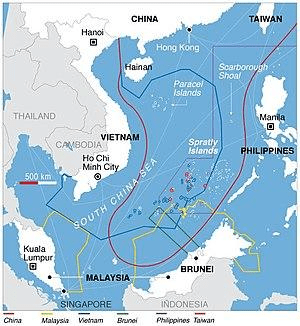
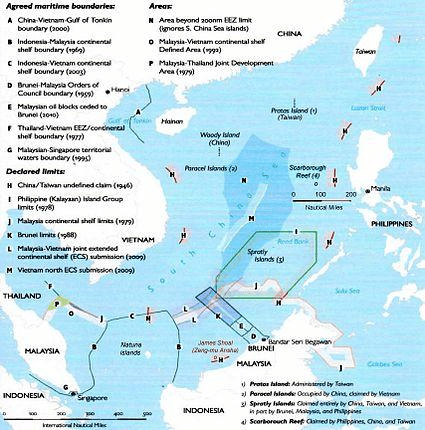
I don’t know what you see, but I see a hot mess with no outright clear “owner” despite the various parties’ statements and claims to the contrary. It’s kind of like a bunch of neighbors in a subdivision who all have property bordering on a communal lake, and they are fighting over who controls it. And just like we do with kids when they are fighting over something and tell them if they can’t settle it, then we adults will, the same applies here.
International law allows for 12 nautical miles out from a nation’s shores to be their territorial waters, with the potential for an exclusive economic zone up to 200 miles out. When you get into a confined space such as this, 200 miles out starts colliding and overlapping with everyone else.
What we need to do is have everyone sit back, focus on their 12 mile territorial waters, and then the main body of the South China Sea remains international waters and the competing countries all work cooperatively together to start a multi-national company to exploit the natural resources of the area, administer any islands in it jointly, and split the profits equally amongst all of the involved nations on a percentage basis using their total populations as the percentages.
Trans-Pacific Partnership—The pulling out of the TPP was a mistake and all it did was isolate the US and make it harder for us to get our way in the greater Pacific region, and leave the nations of the Pacific more vulnerable to Chinese domination. Again, the only way to be a true leader in the world is to be in the room, and by pulling out of a deal that was going to be mutually beneficial to all parties, we took a walk and no one followed. That’s not leadership, that’s just a guy taking a walk.
Chinese Human Rights Abuses—We always have to be careful to not shove our social mores down the throats of other nations, but at the same time to be American is to believe that some of our most basic and treasured values are universal, like due process, fair trials, freedom of speech, of assembly, and of religion. We must continually be shining a light onto abuses of such liberties when dealing with the Chinese to continually make sure they know that we do not accept their behavior and actively advocate for them to change their ways.
Tibet—China has occupied Tibet since 1951. For centuries before that, Tibet was at various times a sovereign empire of its own, or partially under the control of various powers, including the Chinese. Every group of people on the planet has the right to self-determination and the Tibetan people should be no different. Since the Chinese took over Tibet, many Han Chinese have emigrated into Tibet to kind of re-populate the country, which will definitely skew any referendum results, but nevertheless, a referendum must be held amongst the citizens of Tibet, and if the majority want their freedom, then it should be granted to them.
China’s Currency Valuation—China has come a long way in a little over a decade in terms of allowing its currency to float more freely in the world’s currency markets, but it is not yet fully and freely floating and until that happens, China will continue to have an unfair trade imbalance with the rest of the world (making Chinese goods cheaper and everyone else’s goods more expensive). We, the rest of the world, need to put our foot down and get China to stop controlling their currency’s value.
Kashmir—Another hot mess situation left behind from British colonial rule (just wait till we get to the Middle East and Africa!). Essentially Kashmir was an independent country up until the last few centuries when it fell under the rule of various ruling entities, and after the British left in 1947 it has been in a state of uncertainty…..some of it ruled by India, some of it ruled by Pakistan, and some of it taken by China. It is a powder keg purely because all three nations that claim parts or all of it have nuclear weapons.
For decades it has been put forth that the people of Kashmir have a right to self-determination and to take a vote to see what they want to do….independence or rule by one of their current masters. Yet the vote has never taken place for a variety of reasons, and none of them good. At the end of the day this vote must happen, and it has to be impartial, free from undue influence (like having thousands of troops stationed in their area of control), and whatever the results it must be followed, even if it means that the Indian controlled parts want to stay with India and the Pakistan parts want to stay with Pakistan, or if the whole thing wants to be an independent country, or all of it wants to be a part of India or Pakistan or China.
Myanmar—First with the Rohingya crisis/ethnic cleansing and now the last few years with their military coup d’etat, is heartbreaking what has become of Myanmar (formerly Burma). Myanmar had come a long way towards being a good citizen in the world again, and then it goes and does monstrous stuff like this. I’m not sure which is more heartbreaking, that in the 21st century things like this happen or that the international community still doesn’t do much to stop it. Myanmar’s military junta needs to be pressured to leave power and hold truly transparent elections, and if they don’t, then they need to be forced to by the regional and world powers and start treating the people that live in their country the same, whether they are Rohingya or other ethnicities. Enough is enough.
 Perry Waag
You must be logged in to post a comment.